


North American T-28 TROJAN
American military trainer aircraft, which was intended to replace the WWII T-6. It was manufactured by North American Aviation Inc., from whose workshop the P-51D Mustang, AT-6 Harvard and B-25J Mitchell aircraft will also be seen at LEGENDY NEBES.
The first prototype of this aircraft flew in September 1949 and the T-28A began production in 1950. The US Air Force version (T-28A) was powered by an 800 hp engine, while later US Navy versions (T-28B and C) were powered by a 1,425 hp engine. The Trojan's tricycle landing gear taught pilots to take off and land in the same manner as the high-performance aircraft they trained on. Since 1962, the USAF has modified more than 200 T-28As as tactical fighter-bombers for counterinsurgency warfare. Equipped with 1,425-hp engines, these aircraft (re-designated T-28D "Nomad") were effective weapons for close air support of enemy troops in Southeast Asia. A total of 1,948 Trojans were produced. In the mid-1950s, the Trojans were replaced for training by the Beech T-34 Mentor and the Cessna T-37 jet. They remained in the service of the U.S. Naval Air Forces until the 1980s.
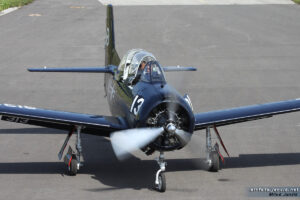
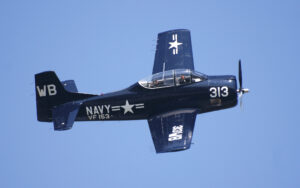
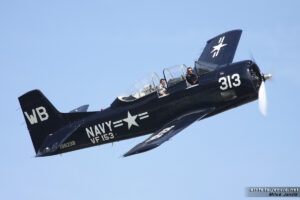
The T-28 Trojan, which will be presented at LEGENDY NEBES 2024 is manufactured under serial number 138238 as the T-28B version, with civilian registration N313WB. In its current livery, however, it refers to the naval version of the T-28D. The latter was not only used as a trainer, but was successfully deployed as a counter-insurgency aircraft during the Vietnam War. The "D" model had six fixed points under the wing for rockets or bombs.
Pilot: Miroslav Sázavský
Specifications:
| Characteristics: | Characteristics: | ||
| Manufacturer: | North American Aviation Inc. | Powerplant: | 1x Curtiss Wright R 1820-86B |
| Crew: | 1 + 1 | Engine power: | 1 425 HP |
| Wingspan: | 12,3 m | Service ceiling: | 11 890 m |
| Length: | 10 m | Range: | 1 670 km |
| Height: | 3,9 m | Maximum speed: | 630 km/h |
| Wing area: | 25,19 m2 | Cruising speed: | 400 km/h |
| Empty weight: | 3 165 kg | Rate of climb: | 19,2 m/s |
| Maximum Take-off weight: | 3 900 kg | Fuel consumption: | 170 l/h |
